
Nepal, officially the Federal Democratic Republic of Nepal, is a landlocked country in South Asia. It is mainly situated in the Himalayas, but also includes parts of the Indo-Gangetic Plain. It borders the Tibet Autonomous Region of China to the north, and India to the south, east, and west, while it is narrowly separated from Bangladesh by the Siliguri Corridor, and from Bhutan by the Indian state of Sikkim. Nepal has a diverse geography, including fertile plains, subalpine forested hills, and eight of the world’s ten tallest mountains, including Mount Everest, the highest point on Earth. Kathmandu is the nation’s capital and its largest city. Nepal is a multi-ethnic, multi-lingual, multi-religious, and multi-cultural state, with Nepali as the official language.
The name “Nepal” is first recorded in texts from the Vedic period of the Indian subcontinent, the era in ancient Nepal when Hinduism was founded, the predominant religion of the country. In the middle of the first millennium BC, Gautama Buddha, the founder of Buddhism, was born in Lumbini in southern Nepal. Parts of northern Nepal were intertwined with the culture of Tibet. The centrally located Kathmandu Valley is intertwined with the culture of Indo-Aryans, and was the seat of the prosperous Newar confederacy known as Nepal Mandala. The Himalayan branch of the ancient Silk Road was dominated by the valley’s traders. The cosmopolitan region developed distinct traditional art and architecture.
Trekking in Nepal
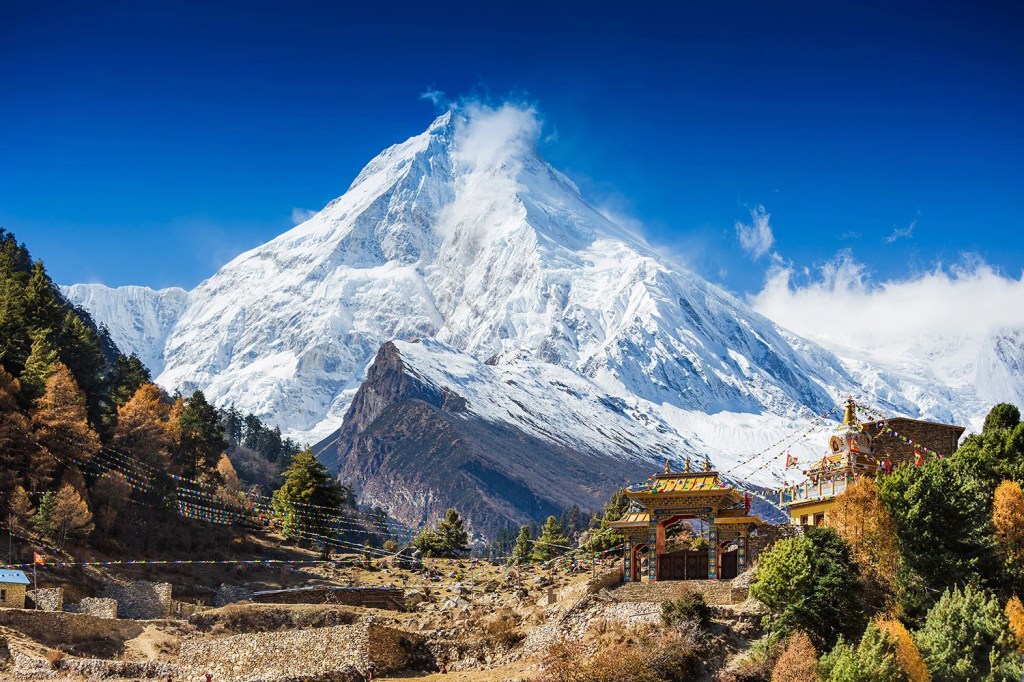
Nepal is the world’s premier destination for trekking and is the country where commercial trekking was pioneered back in the early 1960s.Two of the most popular trekking regions are the Everest and Annapurna where many different trails can be followed while the other popular treks are in the Langtang and Kanchenjunga regions. The most challenging is the Great Himalayan Trails, an extensive trail system that covers Nepal from Humla and Darchula in the west to Kanchenjunga in the east. The diversity of trekking trails in Nepal cannot be found in any other part of the world. In fact, the lowest point in Nepal is 59 m above sea-level in the Tarai region while the highest point is Everest, 8,848 m above sea-level, the two points being only 200 kilometres apart as the crow flies. A majority of visitors to Nepal come in via the Tribuvan International Airport in Kathmandu. It is in Kathmandu that trekkers need to acquire their permits and other documentation, either from a trekking agent or from the appropriate offices. These documents will be checked along the trekking route. For those with little time on their hands, there are half-day hikes from Kathmandu to witness breathtaking Himalayan views.
Trekking in Nepal today is completely different from that of the 1960s. In all the main trekking areas, the National Parks and Conservation Areas lodges have been established where trekkers can find accommodation, food and meet other trekkers and locals along the way. A majority of the trails are well maintained and in many cases are sign-posted.
The lodges are well appointed and have facilities for charging batteries and the larger villages often have email facilities. The length, the difficulty and timing of the treks vary greatly and to add to that once outside of the main trekking areas, transport becomes more problematic and often involves at least two journeys made on domestic scheduled flights. Many treks in Nepal begin with a domestic flight to the starting point and many are in remote areas with no road access. Several days of trekking is required to reach the higher mountain areas from the local centers of population and administration.
Nepal has six distinct and diverse vegetation zones ranging from Tropical below a 1,000 m through Sub-tropical 100m – 200m, Lower Temperate 1,700 m – 2,700 m, Upper Temperate 2,400 m – 3,000 m, Sub-alpine 3,000 m – 4,000 m and Alpine 4,000 m to the snowline, above the snowline it is a Himalaya tundra like wilderness. The higher altitudes are home to the elusive Snow leopard, Himalayan Thar, Musk deer and other rare species.
Although the popular treks in Kanchenjunga, Everest, Manaslu, Annapurna are able to provide lodge accommodation, the less frequented treks in those areas and also in other areas west of Annapurna will generally require camping style trek support.




 Professional sites